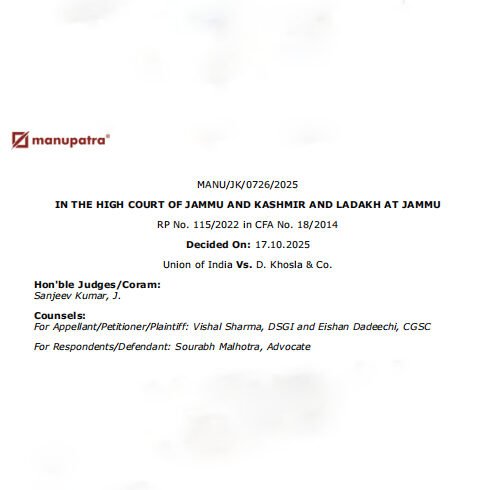
The Judgment of the High Court of J & K and Ladakh, dated 23.05.2018, in the matter of Jammu Motors Pvt. Ltd. Vs. Neelam Kumari & Ors. : RPC 49 / 2018 : MANU/JK/0392/2018, cannot be construed as a good law anent the question of maintainability of a Review Petition post dismissal of Special Leave Petition.
In its subsequent order dated 16.07.2018 : MANU/SCOR/19715/2018, passed in the Special Leave Petition(s), preferred against the abovementioned Judgment dismissing the Review Petition; The Supreme Court expressed its reservation with the view taken by the High Court of J & K, on the question as to whether a Review Petition would lie after the in-limine dismissal of the Special Leave Petition, since the issue was then pending before the larger bench of the Apex Court.
Later, in the year 2019, a three Judge Bench of the Supreme Court, in the case of Khoday Distilleries Ltd. and Ors.Vs. Sri Mahadeshwara Sahakara Sakkare Karkhane Ltd : (2019) 4 SCC 376, whilst re-iterating its conclusions in Kunhayammed and Ors. v. State of Kerala and Anr : (2000) 6 SCC 359, settled the law in this regard to the following effect:
“(iv) An order refusing special leave to appeal may be a non- speaking order or a speaking one. In either case it does not attract the doctrine of merger. An order refusing special leave to appeal does not stand substituted in place of the order under challenge. All that it means is that the Court was not inclined to exercise its discretion so as to allow the appeal being filed.
(v) If the order refusing leave to appeal is a speaking order, i.e., gives reasons for refusing the grant of leave, then the order has two implications. Firstly, the statement of law contained in the order is a declaration of law by the Supreme Court within the meaning of Article 141 of the Constitution. Secondly, other than the declaration of law, whatever is stated in the order are the findings recorded by the Supreme Court which would bind the parties thereto and also the court, tribunal or authority in any proceedings subsequent thereto by way of judicial discipline, the Supreme Court being the Apex Court of the country. But, this does not amount to saying that the order of the court, tribunal or authority below has stood merged in the order of the Supreme Court rejecting the special leave petition or that the order of the Supreme Court is the only order binding as res judicata in subsequent proceedings between the parties.
(vi) Once leave to appeal has been granted and appellate jurisdiction of Supreme Court has been invoked the order passed in appeal would attract the doctrine of merger; the order may be of reversal, modification or merely affirmation.
(vii) On an appeal having been preferred or a petition seeking leave to appeal having been converted into an appeal before the Supreme Court the jurisdiction of High Court to entertain a review petition is lost thereafter as provided by Sub-rule (1) of Rule 1 of Order 47 Code of Civil Procedure.
(c) Once we hold that law laid down in Kunhayammed is to be followed, it will not make any difference whether the review petition was filed before the filing of special leave petition or was filed after the dismissal of special leave petition. Such a situation is covered in para 37 of Kunhayammed case.”
In view of the above conclusions arrived in Kunhayammed and Ors. v. State of Kerala and Anr : (2000) 6 SCC 359; the three Judge Bench of the Supreme Court in Khoday Distilleries Ltd. and Ors.Vs. Sri Mahadeshwara Sahakara Sakkare Karkhane Ltd : (2019) 4 SCC 376, further concluded that if Special Leave Petition was dismissed in limine and without any speaking order and after the dismissal of the Special Leave Petition, the Respondent had approached the High Court with Review Petition; such a Review Petition was maintainable and the High Court was empowered to entertain the same on merits.
The pronouncement in Khoday Distilleries Ltd. and Ors.Vs. Sri Mahadeshwara Sahakara Sakkare Karkhane Ltd : (2019) 4 SCC 376 has finally settled an almost two decade old controversy, which had resulted in conflicting views of the High Courts on the aforesaid question of law.